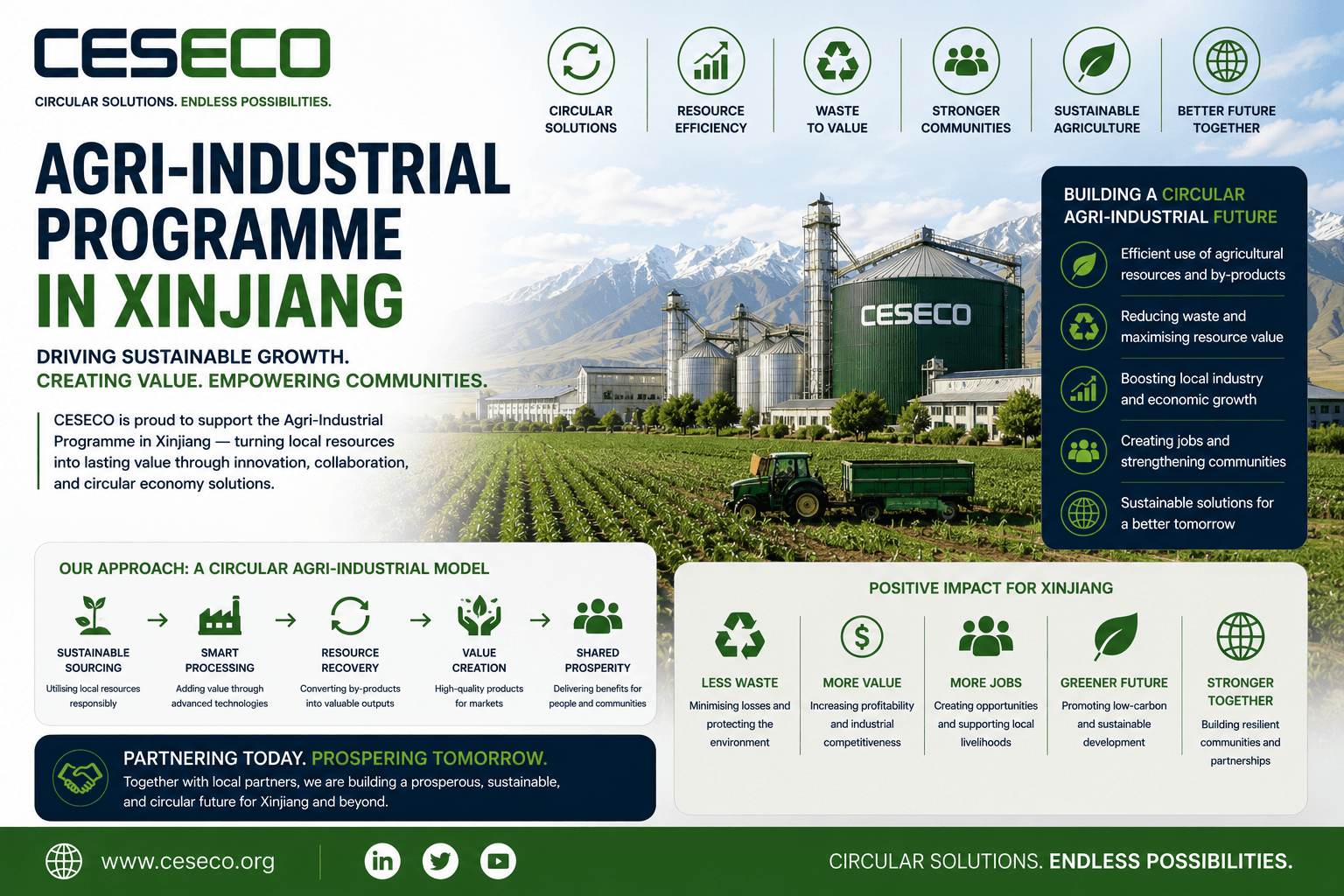
CESECO to Anchor a 20,000-Hectare Agri-Industrial Programme in Xinjian
CESECO has confirmed plans to anchor a new 20,000-hectare agricultural programme in Xinjiang, scheduled to commence in 2026. A launch meeting is planned for November to define technical scope, permitting, and development sequencing in collaboration with central and provincial authorities.
The multi-phase initiative will be centred around an integrated Eco Park model combining animal husbandry, feed milling, automated indoor greenhouses, fertiliser and biogas production, CO₂ recovery, and high-quality PAF and PAP outputs for feed and pet-food industries. It will also include comprehensive facilities for animal disease management and form a key supply-chain hub for sustainable aviation fuel (SAF) and biofuel producers. The project directly supports China’s national objectives on resource efficiency, circular economy, and low-carbon transformation set out in the 14th Five-Year Plan.
Why Xinjiang, and Why Now
Xinjiang is rapidly scaling its capabilities in smart agriculture, with new demonstration zones focused on intelligent greenhouses, vertical farming, and precision livestock systems. These developments provide an ideal foundation for CESECO Ecology Parks’ integrated approach to agricultural modernisation.
China’s policy framework continues to emphasise rural revitalisation, agricultural waste utilisation, and green growth—all central to the ‘Ecology Parks’ model. National targets call for the comprehensive utilisation of more than 80 per cent of livestock and poultry manure by 2025, highlighting the urgent need for industrial-scale, closed-loop treatment and resource recovery systems.
Phase One: Rendering-Led Industrial Backbone
The first phase will see CESECO establish a rendering facility capable of processing approximately 320,000 tonnes per year, providing the hygienic and traceable feedstock base for downstream fertiliser, biogas, PAF/PAP, and pet-food production. Within five years, total rendering capacity is expected to double as additional park modules come online. This “rendering-first” strategy aligns fully with China’s Solid Waste and livestock waste-management standards, ensuring both environmental compliance and maximum resource efficiency.
SAF and Biofuels: Building a Sustainable Feedstock Base
China’s energy and aviation sectors are advancing steadily towards commercial-scale sustainable aviation fuel and biofuel production. With new technical centres and pilot plants emerging, reliable and traceable feedstock supply chains will become increasingly critical. CESECOs’ integrated rendering and biogas systems are designed to deliver compliant, bankable feedstock streams that will underpin these growing green-fuel industries.
Policy Alignment and National Priorities
The project supports several key national goals:
- Circular Economy (14th Five-Year Plan): Expansion of industrial symbiosis, recycling systems, and resource productivity.
- Rural Revitalisation: Enhancing agricultural efficiency, pollution control, and rural employment.
- Manure Utilisation Targets: Achieving at least 80 per cent re-use by 2025 through large-scale treatment and recycling.
- Solid Waste Law Compliance: Safe and traceable management of animal by-products and organic waste.
- Bioenergy Expansion: Development of biogas, biomass, and related carbon-reduction industries.
CESECO Leading the Next Generation of Eco-Industrial Solutions
CESECO combines proven engineering with innovative sustainability design. Its modular systems integrate:
- Advanced rendering and biosecurity processes meeting international standards;
- Biogas and CO₂ capture to decarbonise agri-processing and supply industrial CO₂ users;
- Digital traceability platforms for emissions and quality monitoring; and
- Downstream market connections into pet-food, feed, fertiliser, and renewable-fuel sectors.
This flagship programme places CESECO at the forefront of delivering the next generation of sustainable agricultural infrastructure, supporting China’s drive towards green growth, food security, and circular resource utilisation.
Footer Notes / References
- People’s Republic of China, 14th Five-Year Plan (2021–2025) – National priorities on green development, innovation, and rural revitalisation.
- National Development and Reform Commission – 14th Five-Year Plan on Circular Economy.
- Ministry of Agriculture and Rural Affairs – 2025 “No.1 Central Document” (rural priorities and waste utilisation).
- Chinese Solid Waste Pollution Prevention and Control Law (2020 Revision).
- OECD & IEA Bioenergy – Reports on China’s biomass, bioenergy, and biogas development.
- Official and media coverage of Xinjiang’s agricultural modernisation and smart-farming demonstration zones (2024–2025).
