How CESECO Supports Food Security Through Innovation and Supply Chain Resilience
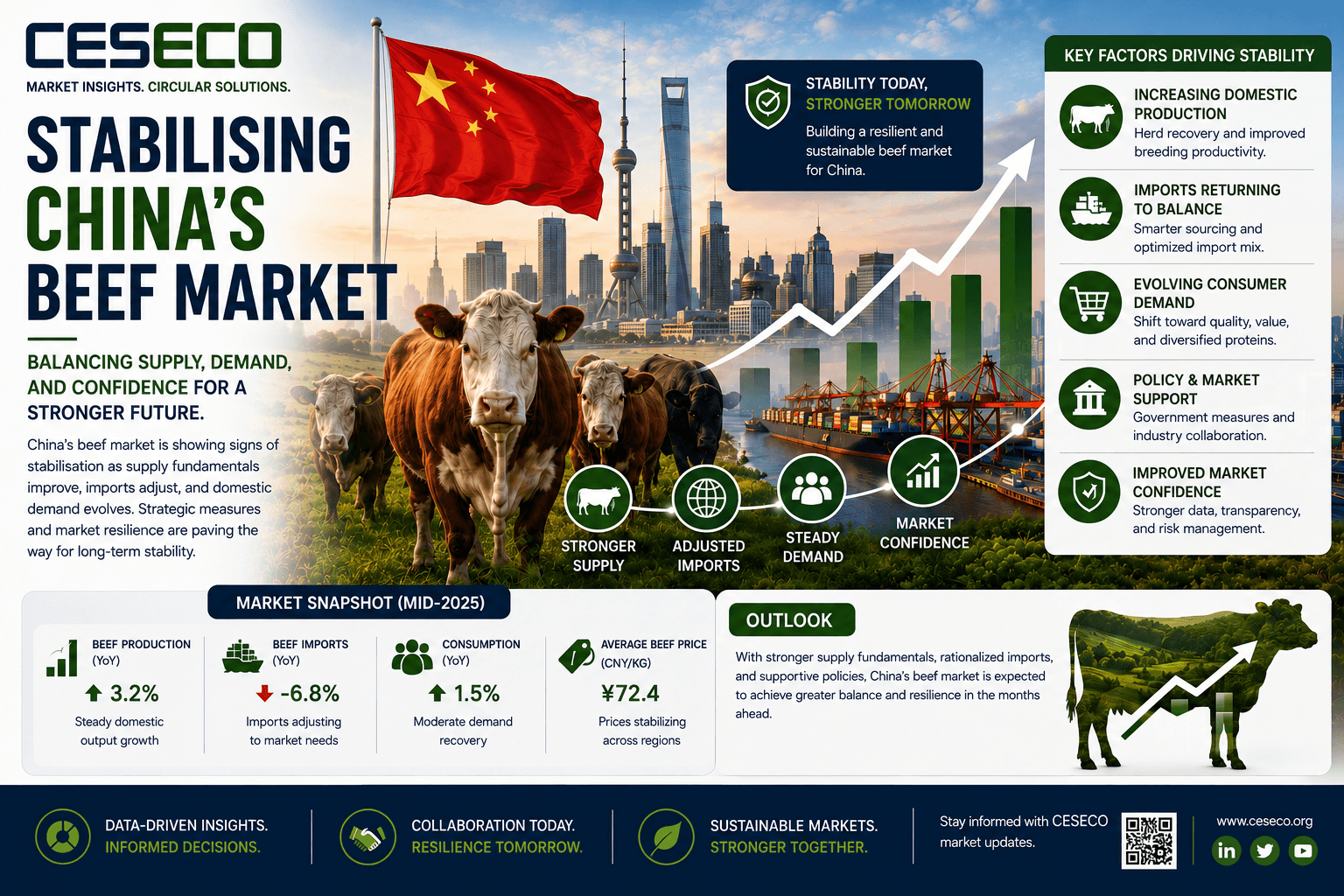
The first half of 2025 marked a pivotal moment for China’s beef industry. Amid a volatile supply chain and ongoing import restrictions, the Chinese beef cattle market experienced its sharpest price rebound in three years. Yet behind this recovery lies a broader story—a shift toward greater food security, domestic resilience, and smarter supply chains.
At CESECO Ecology Parks, we are supporting this shift not just with words, but through on-the-ground action. By introducing a new model of localised circular economy production, we’re helping reduce China’s dependence on volatile imports while stabilising prices and enhancing food safety.
A Market in Transition: Price Reversals and Supply Shocks
According to the National Bureau of Statistics, as of June 2025:
- Live cattle prices averaged ¥27.82/kg (~$3.85 USD/kg), up 8.1% since the end of 2024.
- Key producing provinces like Henan and Guizhou saw increases of 16.7% and 13.0%, respectively.
- Wholesale beef prices rose to ¥63.99/kg (~$8.85 USD/kg), up nearly 5% year-on-year, with some markets posting gains over 20%.
What’s driving this price surge?
- Import Restrictions: A Ministry of Commerce investigation into foreign beef dumping reduced imports by 14% year-on-year in H1 2025.
- Capacity Reductions: Domestic cattle inventory fell 8.3% from its peak in 2023, largely due to unsustainable breeding losses.
- Delayed Slaughter Effects: As profitability returns, cattle weights have normalised, but the supply chain remains constrained.
CESECO: Redefining Agricultural Supply Chains in China
CESECO is actively addressing these structural challenges by building integrated agri-industrial ecosystems across China.
Here’s how:
Localised, Vertically Integrated Ecosystems
CESECO Ecology parks are designed to be self-sufficient ecosystems:
- We convert animal by-products into high-value protein meals, fats, and bio-fertilisers.
- These products are used locally in feedlots, aquaculture, organic farming, and greenhouse vegetable production.
This drastically reduces:
- Transport and cold-chain costs
- Disease and contamination risks
- Market price volatility
Resilience to Import Disruptions
With China’s beef import dependency nearing 30% in 2024, any policy shock or port disruption has ripple effects. CESECO’s circular approach helps insulate regions from global shocks, while:
- Shortening the time to market
- Lowering the need for foreign inputs
- Reducing reliance on inconsistent global pricing
Supporting Breeding and Processing Infrastructure
CESECO sites also serve as economic multipliers:
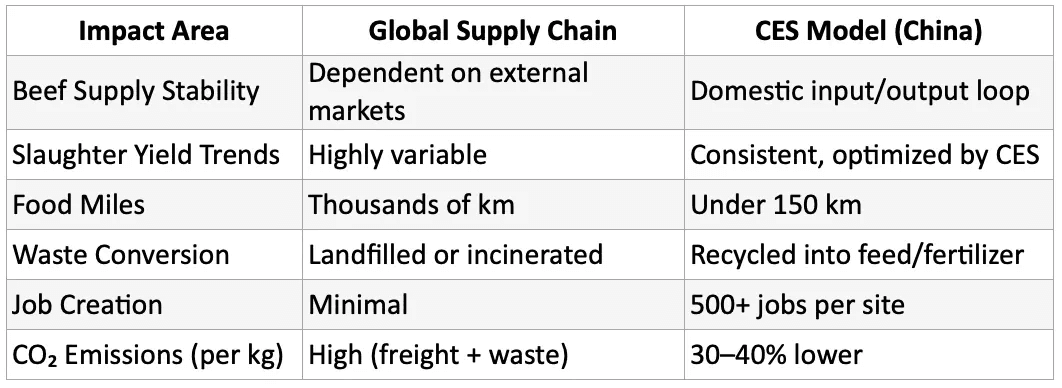
- We create over 500 skilled jobs per park in engineering, logistics, food safety, and biotech.
- We work with local feedlots and cooperatives to expand breeding capacity and improve margins.
- Our bio-refining methods deliver consistent, high-quality feed inputs to reduce operating costs and improve animal health.
Policy Alignment: Enabling Government Goals
CESECO aligns with multiple policy initiatives from China’s national and regional governments, including:
- Dual Circulation Strategy: By stimulating domestic production and reducing external dependencies.
- Rural Revitalisation: Through job creation, training, and rural industrialisation.
- Food Safety & Traceability: With integrated lab testing, source tracking, and digital supply chain platforms.
- Carbon Reduction & Waste Valorisation: Reducing methane from landfills and reusing organic waste as value-added inputs.
Economic and Environmental Benefits
A Platform for Partnership in China
We are currently expanding operations in Henan, Inner Mongolia, and Hunan, and seeking:
- Landowners in key agricultural zones
- Local governments and industrial parks aligned with rural revitalisation goals
- Farmers, feedlots, and slaughterhouses with excess organic material
- Off-takers of our high-quality meals, fats, pet food base, and vegetable produce
- Strategic investors aligned with ESG and food security objectives
To support growth, we are exploring:
- Government grants and subsidies
- Carbon credit frameworks
- Equity incentives for long-term supply and off-take partners
Conclusion: Rebuilding Trust in the Domestic Food Chain
As China’s beef industry enters a new pricing cycle in late 2025 and 2026, structural change—not just market cycles—is the path forward.
CESECO is proud to be part of this transformation. Through innovation, localised ecosystems, and a commitment to food sovereignty, we are building a more resilient, affordable, and sustainable food future for China.
