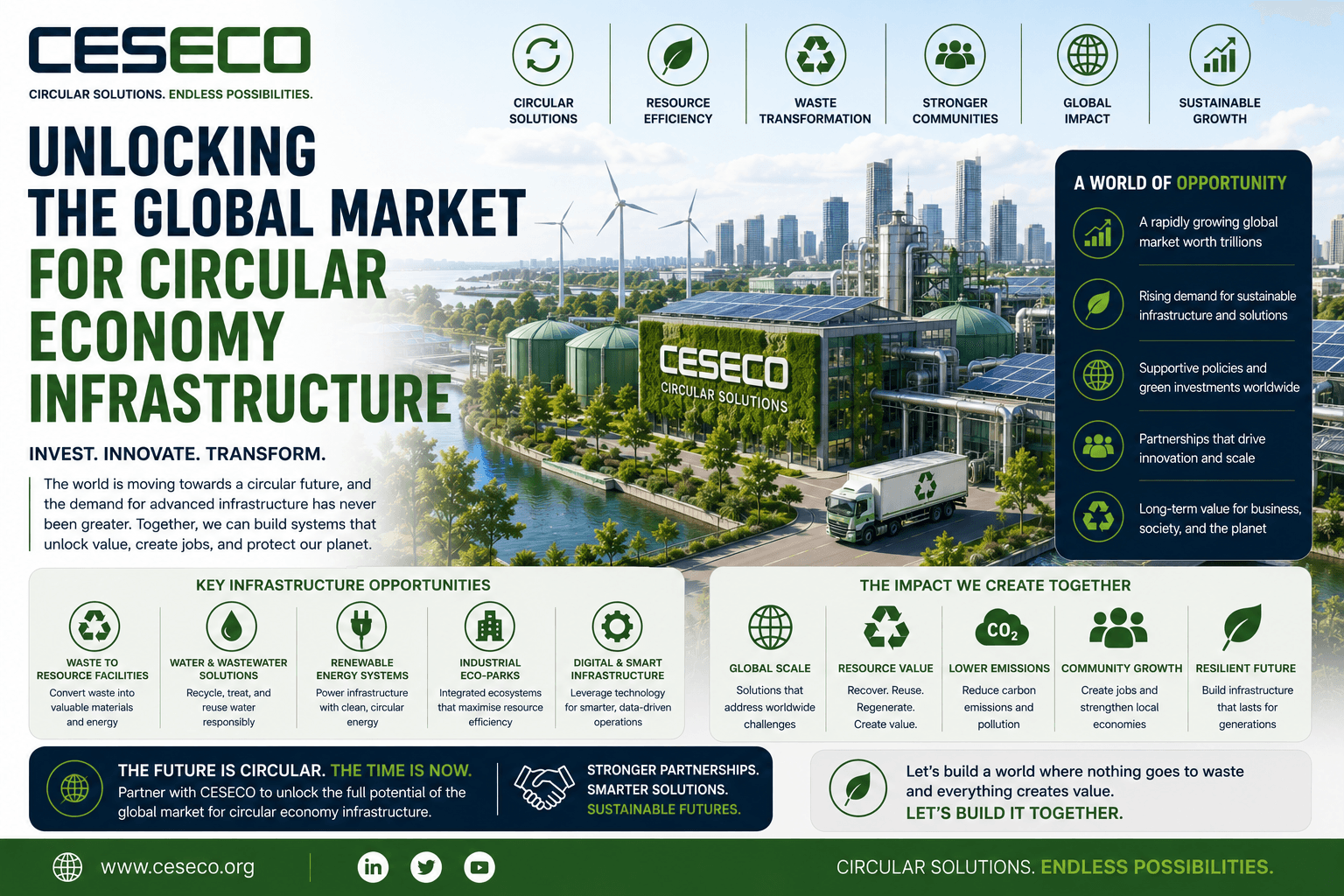
Turning Waste into Wealth: Strategic Expansion in the Circular Economy
CESECO Limited is scaling a transformative circular economy model that turns slaughterhouse and farm by-products into valuable commodities—animal feed, pet food, biofuels, fertilisers, and organic produce—while creating jobs and reducing carbon emissions. This model is replicable, profitable, and urgent.
In this article, we outline:
- The Total Addressable Market (TAM) for CESECO
- Our rapid go-to-market regions
- Long-term high-impact markets
- Funding, grants, and carbon credit potential
- Strategic expansion roadmap
Global Total Addressable Market (TAM)
Circular Economy TAM (Waste-to-Value AgriTech)
- Animal by-product processing market: $16.2B (2024)
- Organic fertiliser market: $14.6B
- Pet food ingredients from waste: $8.9B
- Biofuel from agri-waste: $18.5B
- Sustainable agriculture/greenhouse farming: $29B
- Total TAM: $87B+ (excluding carbon credits and indirect economic uplift)
CESECO operates at the intersection of these sectors, with potential to capture 10–15% market share per country, depending on land access, raw material supply, policy incentives, and off-take demand.
Key Market Drivers
- Volume and consistency of waste from slaughterhouses and farms
- Proximity to logistics and processing infrastructure
- Density of off-takers (feed mills, retailers, wholesalers, fuel processors)
- Regulatory openness and permitting ease
- Tax credits, green funding, and ESG alignment
- Carbon offset markets (credits, incentives)
Rapid Go-To-Market Regions (2025–2027)
These markets offer high readiness, available feedstock, clear off-take demand, and strong policy support.
United States (Texas, North Carolina, California, Florida)
- Why: Large agri-sector, high-volume meat production, access to ports and grants
- Feedstock: Beef, poultry, pork, fish processors
- Off-takers: Feed mills, pet food giants, biofuel plants
- Incentives: USDA climate-smart agriculture grants, state tax credits, Inflation Reduction Act (IRA) carbon provisions
- Funding: USDA REAP, DOE clean tech grants, Carbon Capture & Storage incentives
China (Hunan Province, Inner Mongolia)
- Why: Largest animal protein market, rising ESG standards, focus on food security
- Feedstock: Pig and poultry waste, urban food waste
- Off-takers: Domestic feed industry, government procurement programs
- Incentives: Localised grants, land provision, JV models with provincial governments
- Support: Regional leaders actively seeking CESECO’s expertise and technology
Australia (Victoria, North Queensland)
- Why: Strong export markets, sustainable livestock industry, government climate targets
- Feedstock: Cattle, sheep, fishery waste
- Off-takers: Feed/fertiliser exporters, domestic agri-coops
- Support: Carbon credits under the Emissions Reduction Fund, national bio-economy incentives
United Kingdom (Cumbria, Dorset & North Wales)
- Why: High per-capita meat production, rural regeneration need, post-Brexit subsidies
- Feedstock: Poultry, dairy, lamb, fish
- Off-takers: Feed producers, pet food suppliers, agri retailers
- Incentives: DEFRA Sustainable Farming Initiative, Innovate UK grants, R&D credits
Strategic Expansion Markets (2027–2032)
These regions require more capital, deeper policy navigation, or multi-stakeholder partnerships but offer significant long-term potential.
Brazil
- Largest beef exporter with untapped by-product potential
- Proximity to feed-importing nations
- Requires careful navigation of environmental regulations and indigenous land issues
India
- Expanding dairy and poultry industries
- Government interest in biotechnology, food security, and rural employment
- CES model must be adapted for cultural and religious considerations
European Union (France, Germany, Poland)
- High alignment with ESG targets and the European Green Deal
- Integration with food waste recovery and nutrient recycling
- Funding opportunities from Horizon Europe and EU Innovation Fund
UAE and MENA
- Food import dependency and limited local agriculture
- Strong appetite for green technologies and sovereign fund investment
- Suitable for modular, high-efficiency eco-park deployment
Funding Strategy
Grants and Public Support
- USDA Climate-Smart Commodities (USA)
- Innovate UK, DEFRA rural economy grants (UK)
- Clean Energy Finance Corp (Australia)
- Horizon Europe funding (EU)
- Provincial incentives and technology JVs (China)
Carbon and ESG Credits
- Carbon offset value from methane capture, waste diversion, fertiliser displacement
- Scope 3 ESG credits for major food and pet product brands
- Estimated $20 million+ in carbon credit value per major eco-park
Private and Institutional Capital
- Green infrastructure funds and ESG-aligned private equity
- Circular economy venture funds
- Sovereign wealth funds investing in land-backed circular solutions
Strategic Roadmap
Conclusion: Seizing an $87B+ Global Opportunity
The demand for circular economy infrastructure is global, underserved, and growing fast. CESECO is uniquely positioned to become a category-defining leader by aligning environmental necessity with strong commercial fundamentals.
Through smart market selection, robust local partnerships, targeted public-private funding, and climate-linked incentives, CESECO can help solve some of the world’s most pressing problems while delivering high-value returns to communities and investors alike.
